


Pour les entreprises de rénovation résidentielle, les constructeurs de maisons individuelles et les sociétés de conception-construction aux États-Unis, la numérisation 3D n'est plus un luxe, mais une nécessité opérationnelle. Les applications de numérisation mobiles comme Polycam et Canvas ont constitué un excellent point d'entrée, prouvant qu'inspecter un bien immobilier avec un appareil numérique est bien plus efficace qu'un mètre ruban manuel. Elles ont démocratisé des fonctionnalités essentielles. flux de travail « numérisation vers BIM » pour les pièces simples et les devis de rénovation rapides.
Cependant, à mesure que les professionnels du bâtiment résidentiel s'attaquent à des rénovations haut de gamme, à la restauration de maisons historiques et à des extensions complexes sur plusieurs étages, ils se heurtent inévitablement à des limites technologiques. Lorsqu'un projet exige une précision structurelle absolue, le matériel des téléphones portables s'avère insuffisant. Voici une analyse, basée sur des données, des raisons pour lesquelles les entrepreneurs en rénovation professionnels délaissent les applications grand public au profit d'écosystèmes LiDAR SLAM portables professionnels tels que… Scanner LiDAR FJD Trion V4e et FJD Trion P2.
1. Franchir le « mur de la précision » : Dérive d'échelle vs. SLAM rigide
Les applications mobiles grand public s'appuient fortement sur la photogrammétrie visuelle et des capteurs de profondeur grand public à faible consommation. Si leurs performances sont acceptables dans une petite salle de bain bien éclairée, leur précision se dégrade de façon exponentielle sur des surfaces plus étendues.
- La réalité des applications mobiles : Scannez une luxueuse maison de 280 mètres carrés avec de longs couloirs, des entrées ouvertes et des plafonds voûtés, et les algorithmes visuels souffrent d'une « dérive d'échelle cumulative » . Les murs se déforment, les angles ne se ferment pas correctement et les données « se dispersent » aux étages supérieurs.
- L'avantage FJD Trion : Le Scanner LiDAR FJD Trion V4e Doté d'un capteur LiDAR SLAM intégré et indépendant, il fonctionne sans aucun capteur externe de smartphone. Offrant une portée active réelle de 50 mètres et un suivi jusqu'à 154 600 points par seconde, sa grille laser active matérielle garantit une précision millimétrique. Qu'il s'agisse de cartographier un espace restreint ou une vaste propriété à aire ouverte, sa structure reste mathématiquement rigide, éliminant ainsi tout artefact flottant.
2. Lever la contrainte des extensions de maison « exclusivement intérieures »
L'un des principaux obstacles à la numérisation par téléphone mobile réside dans l'environnement extérieur. La plupart des extensions résidentielles nécessitent une maquette continue et sans faille reliant le plan intérieur à la façade et à la toiture.
Les appareils photo passifs des téléphones portables et leurs capteurs à courte portée sont instantanément inopérants sous le soleil intense et direct des États-Unis. Pour photographier l'extérieur d'une maison avec un téléphone, les entrepreneurs sont souvent contraints d'assembler manuellement différents ensembles de données, un processus sujet à de nombreuses erreurs humaines.
Intégration harmonieuse intérieur-extérieur : Avec un scanner portable professionnel comme le Scanner LiDAR FJD Trion V4e ou P2, l'interférence de la lumière du soleil ne pose aucun problème. Les opérateurs peuvent commencer à scanner une rénovation de cuisine à l'intérieur, sortir par la porte arrière et capturer la façade extérieure, les dimensions du débord de toit et la topographie dans le système de coordonnées exactement identiqueL'enveloppe complète du bâtiment est enregistrée dans une seule visite virtuelle unifiée.
3. Suppression de la « taxe sur le paiement à la numérisation » (Liberté sans abonnement)
Au-delà des limitations matérielles, les modèles économiques des applications grand public sont confrontés à des frictions financières constantes. De nombreuses applications légères fonctionnent selon le principe du SaaS : elles attirent les utilisateurs avec des téléchargements à bas prix sur les plateformes de téléchargement, mais facturent ensuite des prix élevés. frais au pied carré Ou encore des abonnements mensuels récurrents simplement pour exporter un fichier CAO ou Revit exploitable. Sur des dizaines de projets par an, ce « paiement à la numérisation » ampute discrètement des milliers de dollars du chiffre d'affaires d'un entrepreneur.
L'écosystème FJD Trion défend un sans abonnement philosophie. Lorsque vous possédez le matériel, vous possédez vos données spatiales. Le flux de travail principal permet des exportations illimitées et sans limitation via Modèle Web FJD Trion plateforme sans péages continus, offrant une prévisibilité financière claire et un retour sur investissement (ROI) immédiat.
4. Le chemin clair en 3 étapes vers Architecte en chef, AutoCAD et Revit
Les professionnels de la rénovation de petite et moyenne envergure sont par nature pragmatiques ; ils redoutent les logiciels d'ingénierie de nuages de points complexes et lourds qui nécessitent un géomètre expert à temps plein pour être utilisés. Ils ont besoin d'un outil qui parle leur langage de conception naturel.
FJD Trion comble cette lacune en traduisant des nuages de points spatiaux complexes en fichiers de conception prêts à dessiner grâce à un processus simplifié en trois étapes :
| Étape | Action | Laps de temps |
|---|---|---|
| 1. Capture | Parcourez normalement le chantier avec le Scanner LiDAR FJD Trion V4e ou P2 en utilisant l'application de visualisation mobile Trion Scan. | 10 à 15 minutes |
| 2. Télécharger | Déposez directement les données de numérisation brutes dans le moteur cloud automatisé Trion Model Web pour le nettoyage du bruit de fond. | 5 minutes |
| 3. Export | Utilisez la fonction de découpe 2D intelligente pour générer des contours vectoriels nets et automatisés, et exportez un fichier DXF à l'échelle réelle. | Instantané |
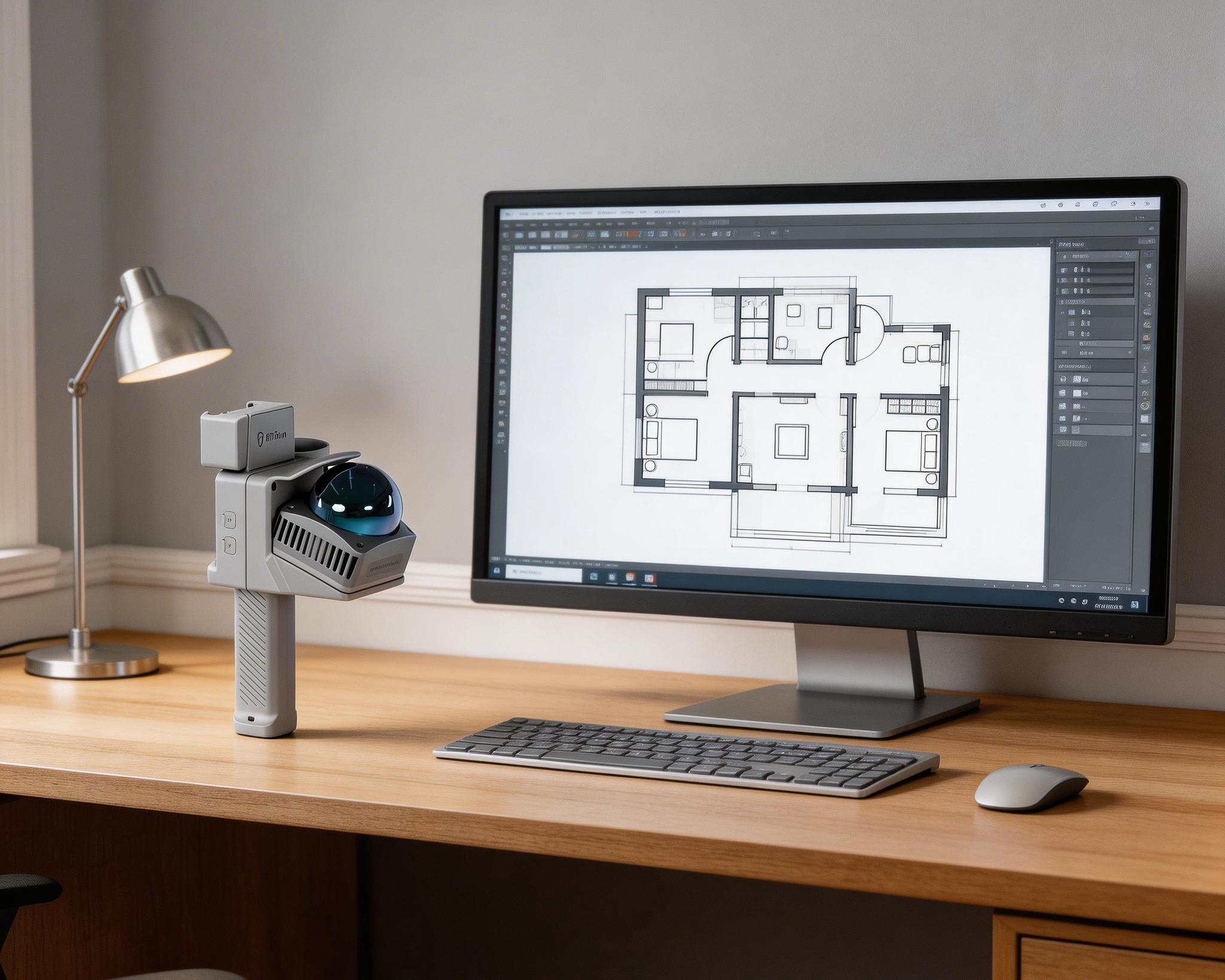
Au lieu de mesurer manuellement avec des répartiteurs ou de se débattre avec un réseau de câbles téléphoniques désordonné et mal aligné, les installateurs peuvent instantanément importer un contour DXF parfaitement mis à l'échelle directement dans Chief Architect, AutoCAD ou RevitCela leur permet de commencer à ériger des murs en 3D et à élaborer des plans d'agrandissement quelques minutes seulement après leur retour du terrain.
En résumé : Des outils professionnels pour des environnements bâtis professionnels
Si les applications mobiles conviennent parfaitement pour créer rapidement des planches d'inspiration ou réaliser des visites virtuelles immobilières, les entreprises professionnelles de conception, de construction et de rénovation exigent une fiabilité matérielle de niveau professionnel. Opter pour un scanner LiDAR SLAM dédié, comme la série FJD Trion, élimine les dérives d'échelle, permet une cartographie extérieure fiable et supprime les modèles d'abonnement logiciels abusifs. Ne laissez plus les limitations des smartphones grand public dicter la précision de vos projets : passez à la capture de la réalité industrielle.
Foire aux questions (FAQ)
Pourquoi un scanner LiDAR SLAM dédié est-il plus performant qu'une application de scan pour smartphone ?
Les applications pour smartphones s'appuient sur la photogrammétrie visuelle et des capteurs de profondeur grand public à courte portée qui présentent une dérive importante sur les grandes propriétés ou en conditions d'éclairage variables. Un scanner dédié comme le Scanner LiDAR FJD Trion V4e utilise un capteur LiDAR SLAM intégré indépendant de qualité industrielle, émettant activement des impulsions laser pour garantir une géométrie précise à l'échelle réelle jusqu'à une portée de 50 mètres, totalement insensible à la lumière du soleil ambiante.
Le système FJD Trion facture-t-il des frais d'exportation par numérisation ou des frais mensuels ?
Non. L'écosystème de capture de la réalité FJD Trion fonctionne sans abonnement. Contrairement aux applications qui facturent un prix au mètre carré ou un abonnement mensuel pour accéder aux fichiers CAO, FJD Trion vous offre des exportations de données illimitées via Trion Model, vous permettant ainsi de conserver vos données spatiales indéfiniment.
Puis-je importer directement les données FJD Trion dans Chief Architect ?
Oui. La plateforme Trion Model Web propose des outils de vectorisation 2D automatisés. Les entrepreneurs peuvent générer des plans d'étage nets à partir du nuage de points 3D et les exporter directement au format DXF standard, qui peut être importé instantanément dans Chief Architect, AutoCAD ou Revit pour commencer immédiatement le dessin des murs porteurs.
Du scan de terrain à Chief Architect : obtenez instantanément des plans d'étage 2D DXF sans frais d'abonnement.
Comment numériser l'intérieur des cuisines et les façades extérieures en une seule numérisation pour les extensions de maison